
Last mile tracking is the live view of the final leg of your delivery, from the local depot to your door. Your order just got handed to SpeedX, UniUni or OnTrac, a carrier you have never heard of, and the updates went quiet.
That gap is where most delivery worry lives. This guide shows you who has your package, what each status means, and when it will actually arrive.
Track every carrier in one place
Follow SpeedX, UniUni, OnTrac and 1,700+ other carriers with Package Tracker, with live status and delivery alerts in one app — free.

What is last mile tracking?
Last mile tracking is the live view of the final leg of your shipment, the short trip from a local depot to your door. Regular carrier tracking shows you occasional checkpoint scans. Last mile tracking adds the driver’s position and a moving estimated time of arrival.
The phrase has two meanings. Retailers and dispatchers use it for the driver-GPS software that maps a van in real time. As a shopper, you mean something plainer: who has my parcel right now, and when will it land?
How it differs from a normal tracking scan
A normal update is a status code logged when your box passes a checkpoint, such as in transit or arrived at facility. Last mile tracking is continuous: position plus a live estimate, not a scan every few hours. The last leg is also where your parcel flips to out for delivery, then often goes quiet until evening.
Last mile delivery facts worth citing
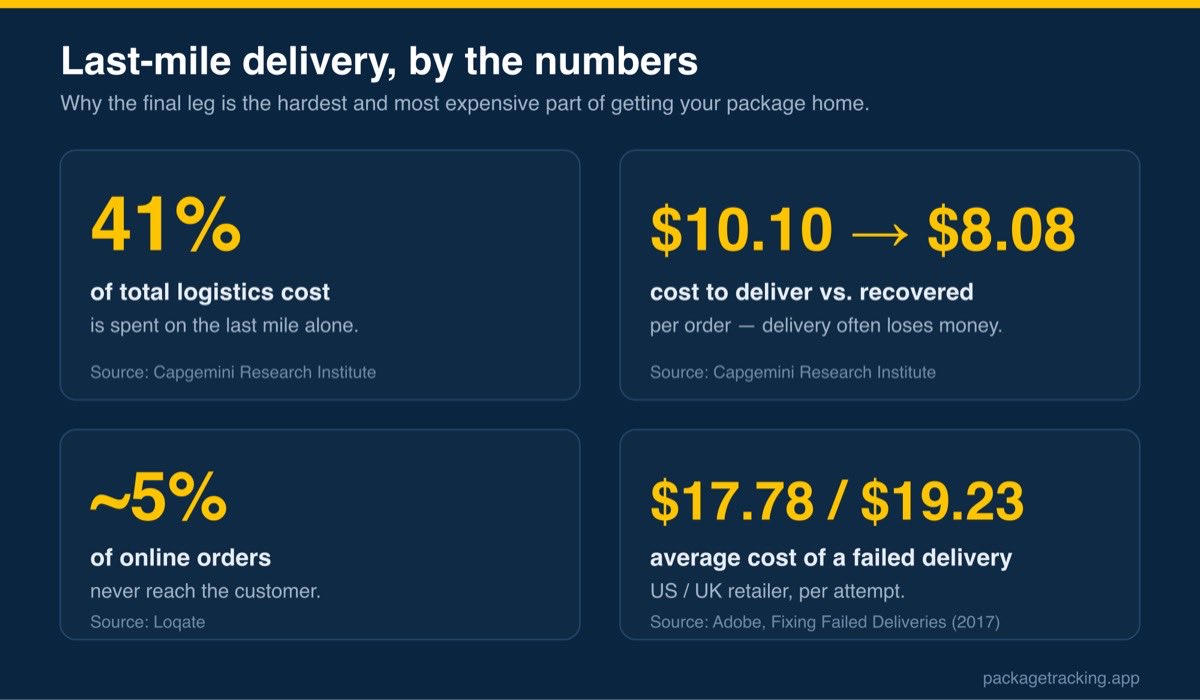
The last mile is small in distance and large in cost. These figures are the ones reporters and analysts quote most, each from a primary source.
| Figure | What it measures | Source (year) |
|---|---|---|
| 41% | Share of total logistics supply-chain cost spent on the last mile | Capgemini Research Institute (2019) |
| $10.10 vs $8.08 | Average cost to deliver one online order vs what the customer pays | Capgemini Research Institute (2019) |
| 97% | Organizations who say their current last-mile model is not sustainable at scale | Capgemini Research Institute (2019) |
In plain terms: the leg that carries your box the last few miles swallows roughly four in ten logistics dollars, and most retailers lose money on each delivery.
Why the last mile is the hardest, most expensive leg
Earlier legs move thousands of parcels together on trucks and planes. The last mile splits them into single stops at single doors, which is where the money goes. Capgemini puts the last mile at 41% of total logistics cost.
The economics are tight. Capgemini found the average online order costs $10.10 to deliver but recovers only $8.08 from the customer. In the same study, 97% of executives said their current model will not scale.
What makes the final stop so hard
Every delivery is unique: a different address, a different access problem, a different person who needs to be home. Traffic, parking, gated buildings and wrong addresses all slow a van that has dozens of stops. One missed door can mean a second trip the next day.
Who delivers your last mile? The carriers you didn’t choose
Nationally, USPS, UPS and FedEx still carry much of the last mile. Increasingly, retailers hand your parcel to regional or gig carriers at the depot, and you never pick which one. That hand-off is the usual reason a tracking page shows a name you do not recognize.
The common US names are Amazon Logistics, OnTrac, UniUni, Veho and SpeedX. LaserShip is now part of OnTrac after a 2023 rebrand, so you may still see LaserShip-style numbers. Here is how to recognize each one.
| Carrier | Number format (example) | Where to track | In Package Tracker? |
|---|---|---|---|
| SpeedX | SPX + ~15 characters | speedx.io | Yes |
| OnTrac | C or D + 14 digits (D10011254054762) | ontrac.com | Yes |
| UniUni | UUS + 13 digits (UUS0570455416253) | uniuni.com | Yes |
| Veho | Often VHO + 12-14 characters | shipveho.com | Yes |
| LaserShip (now OnTrac) | 1LS / LW / LX + digits | ontrac.com | Yes |
| Amazon Logistics | TBA + 12 digits (TBA305477112000) | Amazon order page or app | Via Amazon only |
SpeedX says it makes more than a million deliveries a day and reaches over 80% of the US population. OnTrac delivers across 31 states and Washington, DC, seven days a week. These are real, funded carriers, not placeholders.
Last mile status glossary: what each scan means
The wording on your tracking page is written for the carrier, not for you. This glossary turns each common last-mile status into plain English and a next step.
| Status wording | What it means for you | What to do |
|---|---|---|
| Out for delivery | On a van today; usually arrives by end of day | Be reachable; watch for a delivery photo |
| Arrived at facility / at local depot | At the hub near you, not yet on a van | Normal to wait; can sit 1-3 days in peak season |
| In transit | Moving between facilities | No action; check again within 24 hours |
| Shipment received, package acceptance pending | Label made, carrier has not scanned it yet | Give it 24-48 hours before it moves |
| Delivery exception | Something blocked delivery (address, weather, access) | Read the note; fix the address or arrange redelivery |
| Delivery attempted | Driver came but could not complete it | Look for a card; schedule a redelivery |
| Available for pickup | Held at a depot or locker for you | Bring ID and collect before the deadline |
| Return to sender | Heading back to the retailer | Contact the retailer for a reship or refund |
| Delivered, not received | Driver marked it done | Check around the property, ask neighbors, wait 24 hours, then open a claim |
Seeing your package stuck in transit for a day at the local depot is normal, especially in November and December. A delivery exception, by contrast, always needs a look.
How to track a last mile delivery
You usually have three places to look, and they work best in order. Start broad, then go to the carrier once you know who has it.
- The retailer’s order page: it often names the final carrier and links straight to live tracking.
- The carrier’s own site: once you know it is SpeedX, OnTrac or UniUni, enter the number there for the latest scan.
- Email or SMS alerts: turn them on so the out-for-delivery ping reaches you without checking.
If your orders land with a different regional carrier each time, one app saves the hunt. Package Tracker follows 1,700+ carriers, reads the number, routes it to the right carrier, and shows every status in one list.
Amazon Logistics is the exception. A TBA number only resolves inside your Amazon account or the link in Amazon’s own email, so it will not work on a public carrier site.
Failed deliveries and redelivery: what really happens
Most parcels arrive on the first try, but not all. About 5% of online orders never reach the customer, according to Loqate. In a widely cited 2017 study, a failed delivery cost a US retailer around $17.78 and a UK retailer $19.23 (Adobe, Fixing Failed Deliveries).
First attempts fail more often than people expect. In Loqate’s study, 24% of ecommerce organizations said more than 1 in 10 orders fails on the first attempt, and 74% blamed bad address data. The problem is not only a US one: Germany’s first-attempt success fell from 92.79% to 80.42% in a year, per data reported by urbify.
| Figure | What it measures | Source |
|---|---|---|
| ~5% | Online orders that never reach the buyer | Loqate (via FreightWaves) |
| 24% | Retailers where more than 1 in 10 orders fails first attempt | Loqate, Fixing Failed Deliveries |
| 74% | Failed deliveries blamed on bad address data | Loqate, Fixing Failed Deliveries |
| $17.78 / $19.23 | Cost of one failed delivery, US / UK (2017) | Adobe, Fixing Failed Deliveries |
What to do after a failed attempt
Check the exact status first; attempted and exception both need you. Confirm your address and any entry notes, then use the carrier link to pick a new date or a pickup point. If it flips to return to sender, contact the retailer rather than the carrier.
Is SpeedX, UniUni or a TBA number a scam?
No. SpeedX, UniUni and Veho are newer, venture-backed delivery companies, and a TBA number is Amazon’s own internal tag. Unfamiliar is not the same as fake.
The confusion is normal: the retailer chose the carrier at the depot, so the first time you hear the name is on your tracking page. You can confirm it by matching the number format and tracking on the carrier’s official site.
Real scams look different. A genuine carrier will not text you a link demanding a small payment to release a parcel or reschedule it. If a message asks for card details to complete a delivery, treat it as fraud and go to the retailer’s order page instead.
Frequently asked questions
Last mile tracking is the live monitoring of the final leg of a delivery, from the local depot to your door. It differs from standard tracking because it can show the driver’s position and a moving ETA, not just checkpoint scans. For shoppers it answers two questions: who has my parcel, and when will it arrive?
Last mile delivery is the last step of a shipment’s journey, when a local driver takes it from a nearby hub to the recipient. It is the shortest leg in distance but the most expensive and most likely to go wrong. Capgemini puts it at about 41% of total logistics cost.
A last mile carrier is the company that handles that final leg. It may be a national carrier like USPS, UPS or FedEx, or a regional or gig carrier such as OnTrac, UniUni, Veho or SpeedX. Retailers often hand the parcel to one of these without you choosing it.
Amazon often uses its own Amazon Logistics network, shown by a TBA tracking number. For some areas or oversized items it still uses USPS, UPS or FedEx, so a carrier-style number can appear on an Amazon order. Track a TBA number through your Amazon account rather than a carrier site.
The retailer picked that carrier for the last mile, usually to save cost or speed up a metro delivery. You do not choose it, which is why the name can be a surprise. It does not change your delivery rights with the retailer.
No, both are legitimate US delivery carriers that retailers use for the final leg. You can verify your number on the carrier’s official site. Treat only unsolicited messages asking for payment as suspicious.
A TBA number is internal to Amazon and is not shared with public carrier sites. It only resolves inside your Amazon account or through the link in Amazon’s delivery email. Track it there rather than on a carrier page.
Once a parcel shows out for delivery, it usually arrives the same day, often by evening. Before that, it can sit at the local depot for one to three days, especially in peak season. The out-for-delivery scan is the reliable signal that it is on a van.
High volume, sorting backlogs and driver routing can hold a parcel at the hub before it goes on a van. This is common between November and January. As long as the status still updates, it is moving through the system.
Last mile carrier tracking can show the driver’s live position, your stop number in the route, and a tightening ETA window. Standard tracking usually shows only hub scans logged hours apart. The live view is why the final leg feels more transparent when the carrier offers it.
The carrier logs an attempted or exception status and usually tries again the next working day. You can often reschedule or redirect the parcel to a pickup point from the tracking link. If it is returned to sender, contact the retailer for a reship or refund.
Start with the retailer’s order page, which names the final carrier, then use that carrier’s own site. If your parcels keep arriving with different regional carriers, a multi-carrier app like Package Tracker keeps every status in one place. It follows more than 1,700 carriers, so you do not need a separate site for each.




1 Comment