
Wondering what does in transit mean for a package? You refreshed the tracking page, and it still says the same thing.
The silence makes it feel like your order is lost or stuck. It almost never is.
In transit means your package left the sender and is moving through the carrier network toward you. This guide shows what it means, how long it should take, and when to act.
Track Every In-Transit Scan Free
Package Tracker follows your in-transit package across 1,700+ carriers and pushes you an alert the moment it moves or arrives — free.

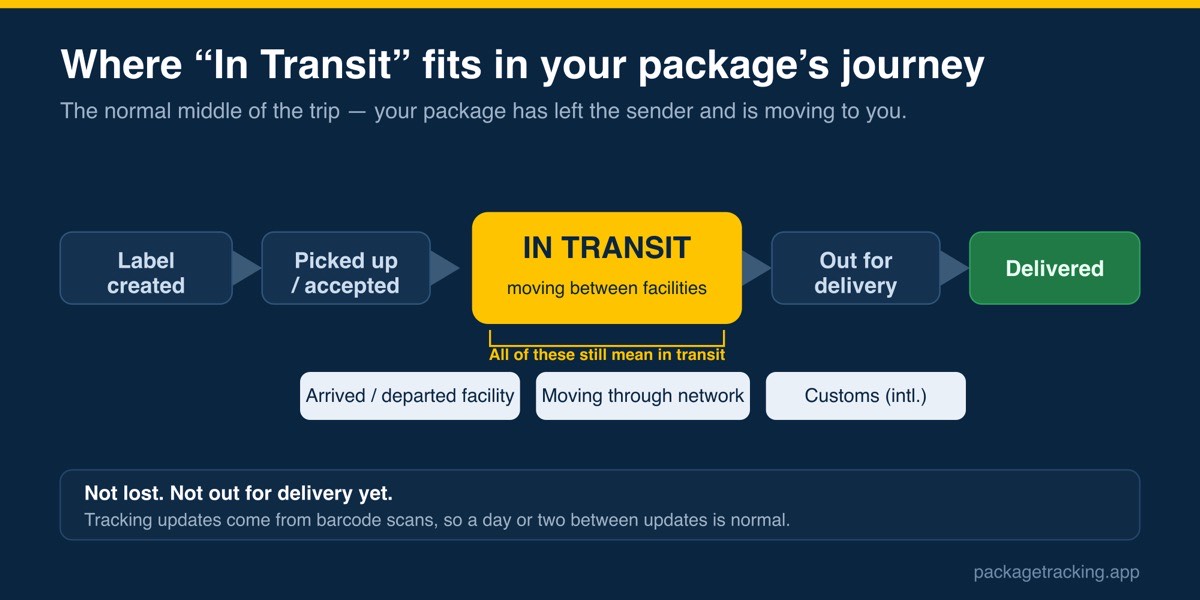
What “In Transit” Actually Means for Your Package
In transit means the carrier has your package and it is moving through their network between facilities toward your address. It has left the sender. It is not out for delivery yet, and it is not lost.
Think of it as the long middle of the trip. Your package rides on trucks, planes, and through sorting hubs, getting scanned along the way.
Why it can look stuck when it is not
Tracking updates come from physical barcode scans, not live GPS. The status changes only when a worker or machine scans the label at a checkpoint.
So your package can travel hundreds of miles between two scans. A day or two with no update usually means it is between hubs, not sitting still.
What in transit does not mean
It does not mean a truck or plane is moving this second. Your package may be resting at a sorting center while the status still reads moving through network.
It also does not signal a problem. The status before this was often shipping label created or an acceptance scan, and the next big step is out for delivery.
Where In Transit Sits in the Shipment Journey
Every package moves through roughly the same set of tracking statuses in order. In transit is the stretch in the middle, after pickup and before the final day.
Here is the full journey, with the plain meaning of each status you might see.
| Tracking status | What it means for you |
|---|---|
| Pre-shipment / Label created | The sender bought a label and your tracking number is live, but the carrier has not picked up the package yet. |
| Picked up / Accepted | The carrier now physically has your package and the delivery clock officially starts. |
| Arrived at facility | Your package reached a sorting center and was scanned in, waiting to be routed onward. |
| Processed through facility | The package was sorted at that hub and assigned to the next leg toward you. |
| Departed facility | Your package left that center and is heading to the next one by road or air. |
| In transit | The package is moving between facilities; this is the normal, healthy middle of the trip. |
| Customs processing (international) | Your international package is being inspected and cleared, which can add days. |
| Arrived at local facility | The package reached the delivery center nearest you; delivery is usually about a day away. |
| Out for delivery | Your package is loaded on the local van and scheduled to arrive today. |
| Delivered | The carrier recorded it as handed over or left at your address. |
| Delivery attempted / exception | The carrier could not complete delivery and will usually retry or hold it for pickup. |
| Available for pickup | The package is waiting for you to collect it at a carrier location or locker. |
| Delayed / arriving late | The package is still moving but running behind its original estimate. |
| Return to sender | The package could not be delivered and is heading back; contact the sender to re-ship. |
The statuses before in transit
A shipping label created or pre-shipment status means the sender printed a label but the carrier has not taken the package yet. Nothing is moving.
You might also see shipment received, package acceptance pending, which means the carrier logged the package but has not scanned it into the network.
The statuses after in transit
Once your package reaches the delivery center near you, it shows arrived at facility or a local-facility scan. Delivery is usually about a day away.
The next morning it flips to out for delivery. If something blocks it, you may see a delivery exception or available for pickup instead.
Every Scan Wording That Still Means In Transit
Carriers word the same thing many different ways. All of these scans mean your package is in transit and moving normally.
Seeing a new facility name each day is a good sign. A departed shipping partner facility scan, for example, just means your package left a regional hub that works with the carrier.
| Scan wording you see | What it really means |
|---|---|
| In Transit, Arriving On Time | Moving normally and expected on the original date. |
| In Transit to Next Facility | Travelling between two sorting hubs right now. |
| Arrived at / Departed Facility | Scanned into or out of a sorting center along the route. |
| Processed Through Facility | Sorted at a hub and sent on toward you. |
| Moving Through Network / On its way | In the carrier’s network, between scans. |
| Origin / Departure / Arrival Scan | A checkpoint scan as the package changes hands. |
| Departed Shipping Partner Facility | Left a regional hub that works with the carrier. |
| Customs clearance in progress | Being reviewed by customs on an international shipment. |
| Export Scan / Import Scan | Cleared the origin country or entered the destination country. |
| Forwarded / Redirected | Rerouted to a new facility or address, still in transit. |
USPS wording
USPS shows In Transit, Arriving On Time or Moving Through Network while your package travels toward your delivering Post Office. USPS does not scan at every point, so the status can repeat across facilities and days.
UPS and FedEx wording
UPS shows In Transit, sometimes as Shipped / On the Way, with a scheduled delivery date. On long routes it may not scan again until it reaches the destination hub.
FedEx shows In transit or On the way. FedEx says this does not necessarily mean the package is in a moving vehicle; it may be at a FedEx facility.
DHL, Royal Mail, Amazon, and Canada Post wording
DHL shows In Transit as the shipment moves between origin and destination, and gaps between scans are normal on international routes. Canada Post shows In transit until your package reaches its final processing point.
Royal Mail says On its way or In transit, and for scan-limited services the status may not change for a few days without meaning the item is lost. Amazon simply shows Shipped while the carrier moves it.
In Transit vs Out for Delivery (and Is It Coming Soon?)
In transit vs out for delivery
In transit covers the whole middle of the journey, when your package moves between sorting facilities that can be hundreds of miles apart. Out for delivery is a separate, later status.
Out for delivery means the package is loaded on the local van and scheduled to arrive today. You will usually see an arrived-at-local-facility scan before it switches over.
Does in transit mean it is coming soon?
It means your package is moving normally, but how soon depends on where it is. If the latest scan is near your city, delivery is likely within a day.
If it is still crossing the country or sitting in customs clearance, it may be several more days. Check the carrier’s estimated delivery date rather than the words alone.
How Long Should a Package Stay In Transit?
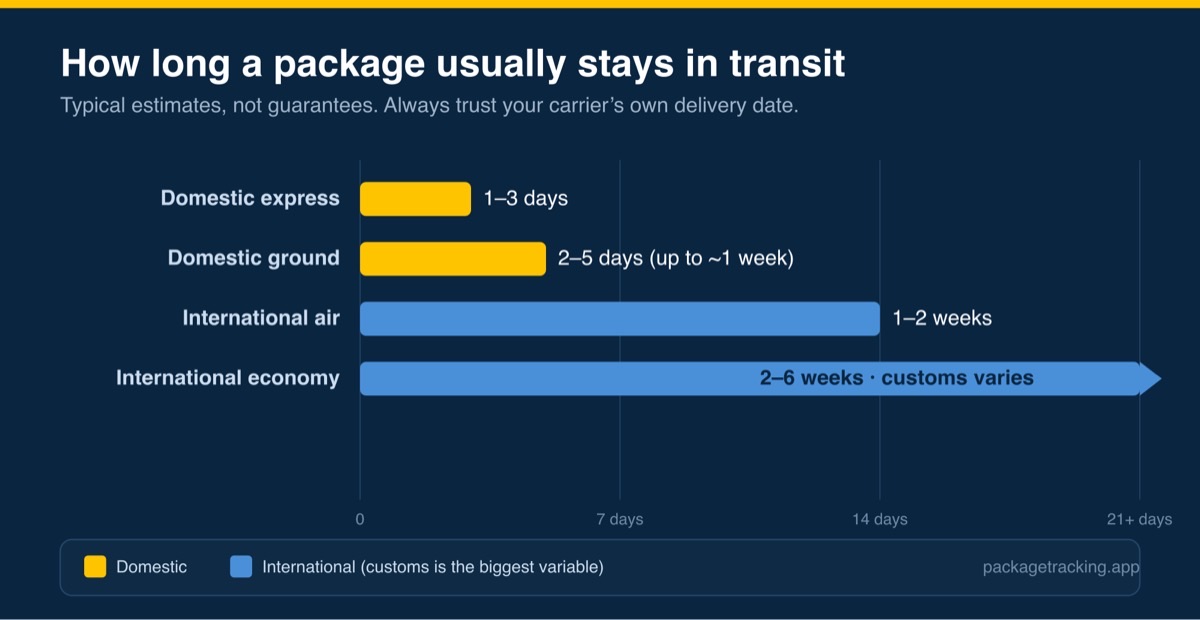
There is no fixed limit, and the ranges below are general estimates, not guarantees. Distance, service level, and customs drive most of the difference.
Use these ranges as a rough guide by shipping speed, then trust your carrier’s own delivery date over the words on screen.
| Shipping type | Typical time in transit | No scan for a day or two? |
|---|---|---|
| Domestic express / priority | 1 to 3 business days | Normal |
| Domestic ground / standard | 2 to 5 business days, up to a week | Normal |
| International air | 1 to 2 weeks, plus customs | Normal |
| International economy / surface | 2 to 6 weeks | Normal |
| Held in customs | A few days to 2+ weeks | Usually still fine |
For a sense of scale on domestic mail, USPS lists Priority Mail at 1 to 3 business days and USPS Ground Advantage at 2 to 5 business days. Your carrier’s own estimate is still the number to trust.
Quiet scans are expected. FedEx notes it is not unusual for a package to go more than 24 hours without a scan while in transit, and USPS scans can repeat across facilities over several days without meaning anything is wrong.
International and customs
International packages spend the longest time in transit, and customs is the biggest variable. A package can read in transit while it actually sits in a customs queue.
If duties or paperwork are outstanding, it can stall until they clear. A week or two in customs is common and does not mean the package is stuck in customs for good.
When In Transit Is Actually a Problem (and What to Do)
A day or two of no movement is not a problem. The real question is how long to wait before you act, and that depends on domestic versus international.
Use these thresholds as your signal to reach out.
The real timeline before you act
For a domestic package, about 7 days with no new scan is the point to open an inquiry. For international, give it roughly 2 to 3 weeks, since customs commonly adds time.
If a package shows a status such as Out for Delivery and is not delivered, USPS suggests allowing up to 24 hours before you submit a service request to your local Post Office. A USPS Missing Mail search can be submitted starting 7 days after mailing.
What to do if it seems stuck
Start with the carrier’s own site or app and recheck the latest scan and the estimated delivery date. Look for an exception or delayed note, which names the cause.
If you bought from a retailer, contact the seller too. The seller is responsible for getting the order to you, and most stores have a window to report a package stuck in transit.
Keep your tracking number ready. If the carrier’s site says your tracking number not working, the number may not be active yet or was mistyped.
Common in-transit scares, decoded
In transit but the delivery date passed usually means a missed connection or weather delay, and the carrier will post a new estimate. Give it a day or two.
In transit for a week on a domestic order is worth a carrier inquiry. A jump straight from in transit to delivered means a final scan was added late, so check your mailbox and any photo on the tracking page.
Can you reroute it while in transit?
Some carriers let you redirect, hold, or reschedule a package while it is in transit, through their own delivery-management service. You usually need a free carrier account tied to your address.
This changes where or when it lands, not how fast it moves. No tool can speed up a package that is already in the network.
Claim windows by carrier
If the package is truly lost, there are deadlines to file a claim. These come from each carrier’s own policy, so confirm the current terms on their site before you file.
| Carrier | When you can report or claim a lost package |
|---|---|
| USPS | Missing Mail search from 7 days after mailing; insured claims from 7 to 15 days, filed within 60 days of mailing. |
| UPS | Report within 60 days of the scheduled delivery date; claim filed within 9 months. |
| FedEx | Lost-shipment claims within 9 months of the ship date. |
| DHL | Contact DHL Customer Service with your tracking number if a shipment stalls past its estimate, then file within DHL’s claim window. |
| Royal Mail | Treated as lost after 10 working days past due (5 for Special Delivery); claim within 80 days of posting. |
| Amazon | Give it a day or two past the estimate; contact within 30 days (Amazon-shipped) or contact the seller. |
| Canada Post | Start an investigation once the expected date passes; file within Canada Post’s claim deadline (about 90 days for domestic). |
For online orders, the seller usually files with the carrier, not you. Keep your order confirmation and tracking number in case they ask for proof.
Watch Every In-Transit Scan in One Place
Refreshing a carrier page over and over is the worst part of waiting. A tracking app does that watching for you.
With Package Tracker you add your tracking number once and see every scan from 1,700+ carriers in one place. You get a push the moment your package moves or goes out for delivery.
It follows USPS, UPS, FedEx, DHL, Amazon, and more, so orders from different stores sit on one screen. You stop guessing and only look when something actually changed.
Frequently asked questions
Most domestic shipments stay in transit about 1 to 5 business days, depending on service and distance. Priority services run 1 to 3 days, while ground can take up to a week. International packages usually stay in transit 1 to 3 weeks, with customs as the biggest variable. Treat these as general estimates and check the carrier’s own date.
A domestic package that is already in transit usually arrives within 1 to 4 more business days. An international one can take another 1 to 2 weeks if customs is still ahead. The carrier’s estimated delivery date on the tracking page is your most reliable guide.
No, they are different stages of the trip. In transit covers the middle of the journey, when your package moves between sorting facilities that can be far apart. Out for delivery is the final-day status, meaning the package is loaded on the local van for your address. Every package passes through in transit first and only switches to out for delivery on the day it is scheduled to arrive.
It means your package is moving normally, but how soon depends on where it is. In transit covers everything from just leaving the sender to arriving at the hub near you. If the latest scan is near your city, delivery is likely within a day, but if it is still crossing the country or in customs, it may be several more days. Check the most recent scan location and the estimated delivery date.
In transit is a good, normal sign. It means the carrier has your package and it is moving through their network toward you. It only becomes a concern if the status does not change for about a week domestically or two to three weeks internationally.
Long in-transit times usually come from distance, slower ground or economy service, high shipping volume, weather, or customs on international orders. Because updates rely on scans, the package can also be moving while the status looks frozen. A domestic package with no scan for about a week is worth a carrier inquiry.
Not directly, because in transit means the package has not reached your local delivery center yet. It must first scan in near you and switch to out for delivery before it can be delivered. Some carriers do let you redirect or hold an in-transit package through their own delivery-management service.
First, do not panic over a day or two of silence, which usually means a missed scan between hubs. If a domestic package shows no new scan for about 7 days, or an international one for two to three weeks, contact the carrier to open an inquiry. Tell the seller too if you bought from a retailer, since they are responsible for the order.
No. In transit only means your package is somewhere in the carrier’s network between pickup and delivery. FedEx states it may be at a facility rather than in a moving vehicle, which is why the status can sit unchanged.
Yes, this happens when the out-for-delivery scan is skipped or added late. Check the delivery location note or any photo on the tracking page first. If you cannot find the package after a few hours, contact the carrier and then the seller.
On a domestic order, a full week in transit with no new scan is worth a carrier inquiry, though heavy volume or weather can slow things without meaning the package is lost. International orders routinely take one to three weeks, with customs as the main delay. Check the latest scan and estimated date first, then contact the carrier and the seller if it has truly stalled.
Not on its own. On an international shipment, in transit can show both before and after customs, and your package may read in transit while it actually sits in a customs queue. Look for a separate customs clearance or released scan to confirm it has cleared.




1 Comment